Sunday, 19 March 2017
Thoughts on Dovetails.
Here's a nice pine box from Daniel. He used the 90 degree guide to pare down to the base line giving a nice flat bottom to his dovetails, good idea. I've seen a few different ways to achieve this, the classic way is to chisel a hump in the middle from both sides and then carefully pare it flat. Personally I prefer a hollow in mine, it's faster, no less strong and gives me the reassurance of no gaps on assembly.
Many woodworkers assume that pine is an easy wood to dovetail, it's soft and forgiving which means you can bang home the joint without much risk of splitting. However that same softness is also a disadvantage as the sides easily collapse under pressure and spoil the crispness of the finished joint.
I've found the best combination for dovetailing is a 'hard' wood for the tails, which hold their crisp shape and a 'softer' wood for the pins with some flexibility. A classic combination is hard maple and walnut, which also gives a strong colour contrast to the joint.
The dovetail alignment board below was Marks first project with his new 1:6 and 90 degree guides and he looks to have done a great job. The alignment board is a very useful tool and a great project to get used to using the guides. It's best made from a single board (quarter sawn if possible) for future stability. If you leave the parts over long then any mistakes made in the joint can be cut off and you can have another go.
Using 3/4" board also makes you appreciate the need for squareness in your dovetails, the thicker the material the more chance your cuts will wander off square and the joint won't fit. This is where the magnetic guides really come in their own keeping the cuts straight, but above all, square.
Nice to see a bit of Blue Spruce tool porn in there!
Tuesday, 14 March 2017
Norris Mount Cutting Knife
I bought this Norris mount cutting knife (made for Buck) ages ago as I really liked the look and feel of it.
The blade is sharpened at a very low angle to a spear pint on both sides of the blade, ie 4 bevels in all. I ground the bevels and finished off on water stones and it gave a super sharp point which was easier to achieve than I had envisaged.
Oliver Sparks made a small batch of modern high quality copies which can see on his Blog
https://www.instagram.com/p/BM_u4O_jrD1/
The other end of the blade had been formed into what looks like a small 'split nut' screwdriver, not exactly sure what for. The picture below shows the construction with a central brass tube and flat sides which were bent over the wood of choice.
Time to use it!
Sunday, 12 March 2017
Curved Dovetail Box Magazine Article
The latest issue of F&C is out now (no 256, April 2017). My article on the making of a curved sided dovetail box is featured if anyone would like to have a go at this technique.
It includes an exploded drawing with all dimensions as well as a full description and lots of pictures.
There is a very good article on the Williams and Cleal Furniture School in Devon showing some of the fine work they do there. I've visited the school and set up and the atmosphere seems to make it a great place to learn.
A two page article on preventing tear out with a hand plane is very interesting, exploring the benefits of a higher angle, tight mouth and a finely set cap iron, although not necessarily together.
An interesting article by Jim Hooker (appropriately) on the sharpening and use of various types of scrapers.
In this issue there are also articles, on hand engraving, Lie Nielsen honing guide, the Geffrye Museum, Robert Ingham, decorative mouldings, antique furniture and planning techniques.
Friday, 10 March 2017
The One Tree Project
Back in 1998 a 179 year old oak was felled on the Tatton Estate in Cheshire and leading craftsmen were asked to design work using very part of the tree. By 2001 the completed work was gathered in and an excellent book was published, see above. Prince Charles wrote the forward to the book. It can be bought second hand on Amazon, enter 'One Tree Merrell'.
One of the standout pieces was the Dory Shelves (below) designed by Petter Southall which harks back to his training as a boat builder in Norway. This one off piece has come back to the market and is for sale at his lovely showroom in West Bay Dorset for £4,950. In comparison to the work he currently sells this is a relative bargain and I'm sure will represent an excellent future investment as well as a lovely piece to own.
https://sladersyard.wordpress.com/petter-southall-furniture/
Another stand out piece is the Romanian Chest which was Alan Peters last significant piece before his sad decline and passing. I was lucky enough to see this when I visited Alan's wife Laura and it was subsequently bought by the Craft Study Centre in Farnham where it was briefly displayed before being locked away in one of their warehouses, shame.
Matthew Burt made this lovely fluted hall table.
Branch oysters were used to make this top, one for the catwalk only!
Robert Ingham made this bench cleverly combining angles curves and straight lines.
I've heard another one tree project is being planed and I very much forward to seeing the results.
Monday, 6 March 2017
Lie Nielsen Block Plane Upgrade
The latest edition of Australian Wood Review is out. This is an excellent magazine that's well worth subscribing, there's only four issues per year so the content quality is very good.
In the tool review section this caught my eye, an upgraded adjuster nut for the lie Nielsen block plane. By using a free running bearing it reduces the risk of loosing lateral adjustment when moving the blade in and out. Ingenious but simple and a bargain at $29 Aussie dollars.
Robert Howard also produces them for Lie Nielsen low angle and shoulder planes.
http://www.thetoolworks.com.au/index.php?route=product/category&path=35_372
A fascinating article on Kumiko also caught my eye.
And six pages on the Mujingfang factory in China is also very interesting.
Saturday, 4 March 2017
Jewellery Box from Canada
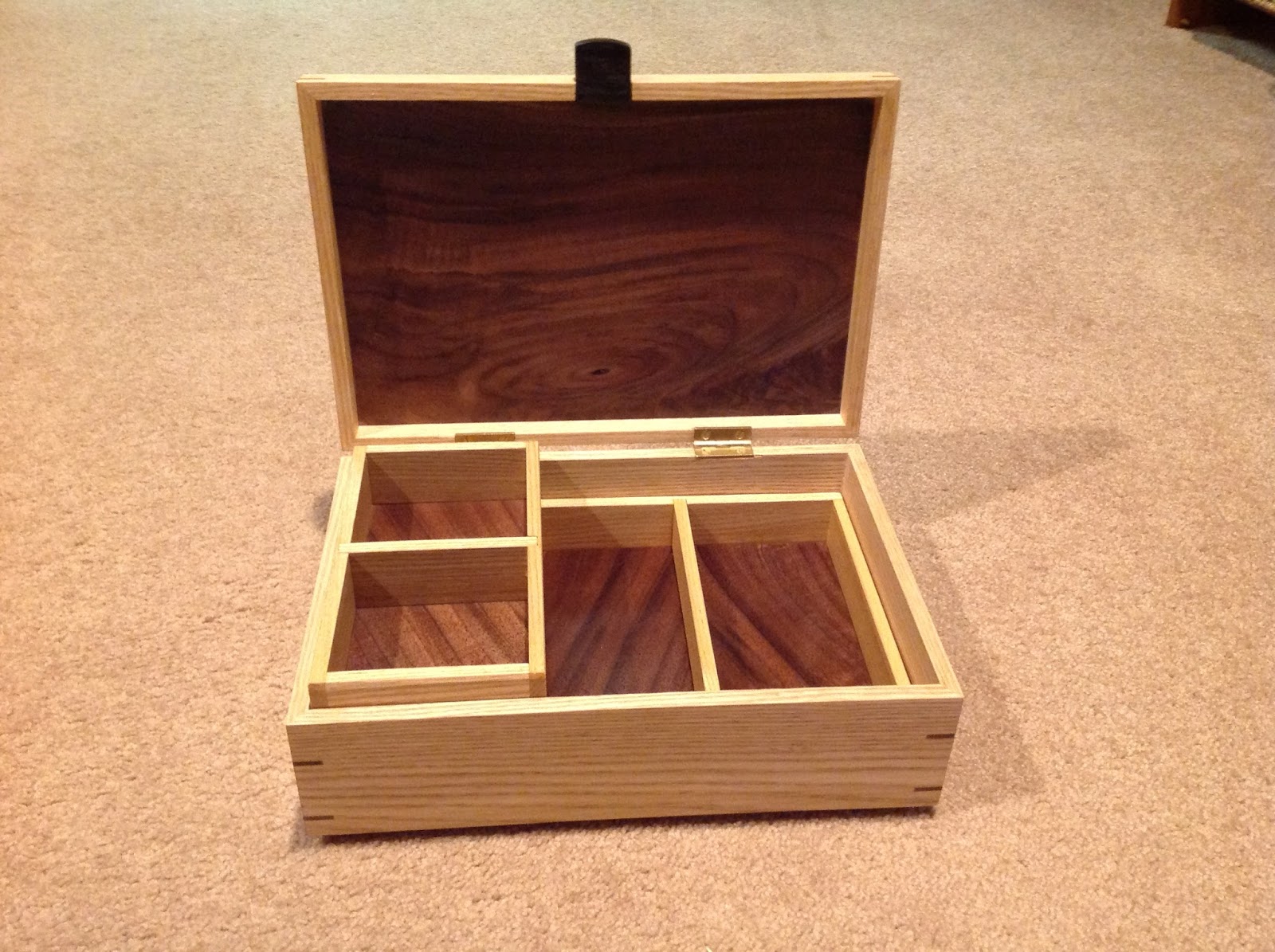
Robert from Canada sent me these pictures of his latest project a very nice jewellery box in Canadian white maple and figured walnut from a tree that blew down in Toronto.
He's planning on lining the box which would finish it off nicely.
Wednesday, 1 March 2017
Jewellery Box Finished
I managed to get round to finishing off the box with the mitred corners and dovetailed Dominoes.
See my first post here
http://davidbarronfurniture.blogspot.co.uk/2017/02/a-great-way-to-reinforce-mitred-corners.html
The tray is a piston fit and the protruding top has been shaped to give a soft close lid.
The little brown oak stand with the shaped feet adds a bit of interest (and time).
The lid opens exactly where the board transitions from the white to the olive coloured ash, which is nice. The floating panel in the lid is some tightly rippled ash, which is not properly visible (I must get better with my camera).
A full article including all the techniques used will be appearing in Furniture and Cabinetmaking magazine later in the year.
The box will also be on display (and for sale) at the Celebration of Craftsmanship exhibition in August http://www.celebrationofcraftsmanship.com/
Subscribe to:
Posts (Atom)