Friday, 4 May 2012

Nice timber

I visited a luthier friend of mine today and bought some very nice  wood. This plank of mahogany was from an  antique dining table, I've cut the scalloped edges off. The wood is very heavy and hard, my friend suspects it might be Cuban Mahogany. 
The downside to reclaimed timber is that it often comes with holes! These are presumably the  holes which attached the top to the frame. I intend to use this plank to make a large box and I can cover the holes with the lining.
These are two 3" thick planks of  Brazilian Mahogany which again will make  some very nice boxes. They are considerable lighter than the mahogany above. 
This is a small board of very nicely figured Zirocote, it's mostly sapwood on the other side . The sap is almost white and very hard, it provides a nice contrast to the dark colour.
A close up of the Ziricote.
The last purchase was a lovely clear board of curly maple 8' 6" long by 12" wide and 1 " thick. I love buying wood  and I very I'm pleased with this little shopping trip. It cost me £500 in total but well worth it!

Wednesday, 2 May 2012

More customer work


 Here's some excellent work sent in by Berin of Somerset, the hallway mirror below is superb,


This 'pretzel' carving must have taken some real patience.


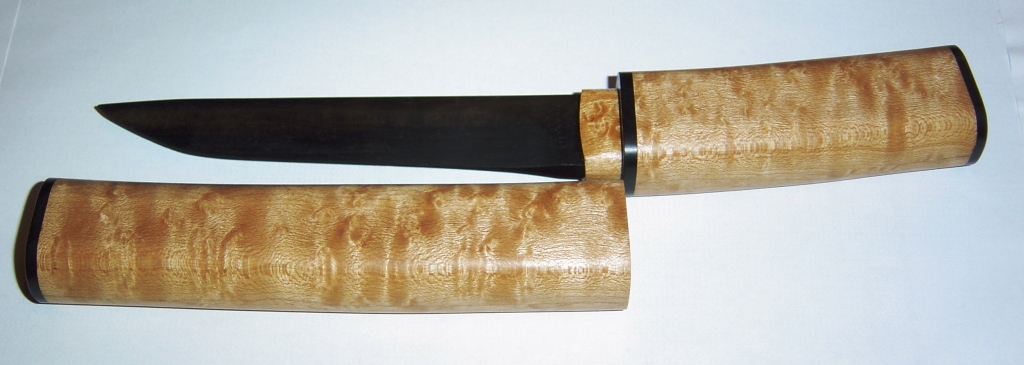
A very useful selection of knives, the top two were styled on my marking knife and the others are definitely Krenov inspired.


A serious selection of home made planes, mostly finished from the tool, again Krenov inspired.


Sunday, 29 April 2012

Customer projects

 I've been sending a lot of tools across the pond in the last few months and it's always nice to hear how people are getting on. It's even nicer to see what they have made. Here is very nicely proportioned blanket chest made by John in Texas. He used my magnetic dovetail guide and mini smoother in the making of this piece.

That's a fine piece of curly maple for the lid panel.


Thursday, 26 April 2012

Here's the box finished ready for the trays and lining to be fitted. The finish I used was 10 coats of thinned  melamine lacquer applied with a cloth. It dries almost instantly so it didn't take too long to apply. I then cut it back with 600 grit abranet followed by 1000 grit to leave a matt surface. An application of a strong carnauba wax blend left a nice sheen. 
The book matched spalted maple was very effective.
 
I bought these 90 degree hinges a while ago from box maker Ian Hawthorne, the grooves are cut on the  router table with an 8 mm bit as per the instructions. Unfortunately the the hinges were really tight and on checking them they were 8.25 mm wide which was a bit of a fiddle to fit. I suspect the chroming caused the size change.

I fitted a delicate handle from African black wood, it took a little while to shape and fit, but little details like this are worth the effort.

Tuesday, 24 April 2012

OOOPPS!!

The lid for the box ended up a fraction undersized. Rather than 'make do', I decided to make a new lid for the  box and a  new box for the undersized lid. The picture above shows the book matched panel being glued up using stretched masking tape on both sides to draw the joint tight.
Here are all the components for the second box. The coloured dots  keep  everything in the right place.
Here is the offending lid, it's only a tenth of a mil undersized but the hinge fitting method needs perfect alignment. 
The new box has conventional through dovetails and it's shown here being supported on a  notched planing board being planed smooth ready for final sanding. I'm not left handed but you need to come at this from both sides in order to avoid break out of the end grain.
Here's the new box assembled ready for the lid to be fitted.


Sunday, 22 April 2012

For cutting the very small dovetails on the trays I use a hand made saw by Mitsukawa
http://japantool-iida.com/saw/index_3.html along with a miniature version of my dovetail guide.


The fine dovetail chisels by Blue Spruce are great for working on a smaller scale. The handles are tough enough to be tapped with a hammer. I made a little tray for the set which is a very useful way of using and storing them. I allowed a space for one of my dovetail marking knives, also with an African Blackwood handle.


Fine, sharp tools are needed for crisp results on this small scale.

The trays all glued up and put on a flat surface to set. I checked very carefully for squareness, taking the reading from the inside of the trays so as not to get a false reading from the protruding dovetails.

Tuesday, 17 April 2012

Jewellry box

I made the outside of this box at the beginning of the year, it's one of those 'no rush' jobs. I'm now going to make the three tays and lid.


I like to finish the inside of the trays before cutting the dovetails, a sharp plane is best on these smaller pieces, sandpaper tends to round the edges no matter how carefull you are. Also the plane is quicker and with a slightly curved edge I can go straight to the shellac and wax finish.


The sides of the trays are 7.5 mm thick by 30 mm high and I like to get nice clean edges which is not really possible with the planer, especially on the curly grain. My method is to clean up one edge on the shooting board and then carefully size on the table saw. I then clean the other edge up with identical strokes (5) to keep the boards all exactly the same height.

My wooden jointer is both effortless and comfortable to use.


Here are the finished parts cut to excat length on the table saw. Note the coloured dots which are very useful. They tell me which is the outside, which is the top and which parts go together. When there is more than one set I add a number to the dots to prevent them getting mixed up.