Sunday, 1 April 2012

Holiday in Jersey

Every year we go on a least one walking holiday and this time it's in Jersey. It was a lovely day but the wind was cold hence the thick clothing. I'm leaning against a German gun from WW2, evidence of their occupation is all along the coast.


My wife Lesley, equally well protected from the wind!


The jersey coastline is fantastic, changing from expanses of wonderful sandy beaches to rugged rocky coves.


Friday, 30 March 2012

Planes finished

I've been diverted to other little jobs, but the planes are finally complete. The smoothers may only be 1" shorter than my 9" model but they feel a lot more compact. Yes I know the jack plane at the back has no blade, I'm waiting for them to come in from Ron Hock.


The rose bubinga has really nice colour, this was the last of the stock bought from Bob at Timberline, he told me the wood was nice, and he was right.


Here's the jack plane, I can't believe I've not made this size before. It's just under 14" and looks good, feels good and is very versatile.


My wife says this looks like a 1930's American car.


Thursday, 29 March 2012

Tool orders

I have been sending tools out on a near daily basis since launching my Blog and videos. The shot above shows an order ready to go to the US, a jointer plane, a high angle smoother, a spokeshave, a scraper shave, a dovetail guide, a chisel hammer and a video. Keep 'em coming!


Before sanding the base smooth on my jack plane I'm levelling the base with a high angle smoother. If I don't do this, biases can be introduced resulting in a slightly skewed mouth, not good!


Here are the two jack planes after shaping on the band saw. I enjoy this part the most as the rough shape is achieved quickly and efficiently.


Saturday, 24 March 2012

Jack Planes and Smoothers

I've just started a small batch of 2 jack planes and 3 smoothers. The jack planes are 13 1/2" long and a good general purpose size, this is a new plane to my range. The smoothers are 8" long and have a 1 1/2" Hock blade, this is the size favoured by James Krenov. I use a perspex template to mark out the shape and the position of the cross pin hole.


I prefer to drill the holes for the cross pin before separating the sides.


I set the drill press so that the spur just breaks through to the other side. I then turn the blank over and complete the hole from the other side.


A perfect hole with no breakout.


I also like to create the chamfers on the drill press. This conical bit from lee Valley gives excellent results.


Here are the sides separated on the band saw. I use a Lennox Trimaster carbide tipped blade and it gives a very smooth cut requiring the minimum of clear up.


Cleaning off the band saw marks with a Stanley No81 scraper fitted with a Hock blade, an awesome combination!


The centre section has the bed angles marked on ready for cutting on the band saw. These good quality bevel gauges from Chris Vesper hold their setting perfectly, avoiding costly mistakes.


Routing the groove for the screw head to ride in, using a template and a guide bush.


Gluing up the jack planes, you can never have too many clamps!!


Thursday, 22 March 2012

Dovetail marking knives complete

This small batch is now complete. Rather than use the buffing wheel to finish I used three coats of melamine laquer which was rubbed out with micromesh to 3,600 grit. After applying wax this left a lusterous and flawless finish with good clarity. It took longer but was worth it.


Each knife comes boxed with a full set of instructions for sharpening etc.


Here are some in Brazilian Tulipwood a very hard and pretty timber with salmon pink stripes running through the cream wood.

Monday, 19 March 2012

Norris plane restoration

Here is a Norris A6 I bought. It was in a sorry state with three separate cracks in the rear handle. The picture above shows it after being glued up with epoxy resin, all the excess glue and irregularities need sanding smooth. I worked from 240 grit through to 600 grit.
This was followed by 5 thin coats of shellac applied with a cloth then left to harden for a few days. This surafce was then worked with 400 grit until matt all over and then worked all the way through to 4,000 grit micromesh. The last coat was with a carnauba wax to give a nice protective sheen. The rosewood was a nice surprise and this was a pleasing restoration.

My aim was to leave the wood as natual looking as possible, I didn't sand too hard leaving as many of the old bumps and knocks as I could. The rubbing out removed all of the telltale cloth marks and left the surface matt so that the application of wax only raised a sheen and not a high gloss finish.


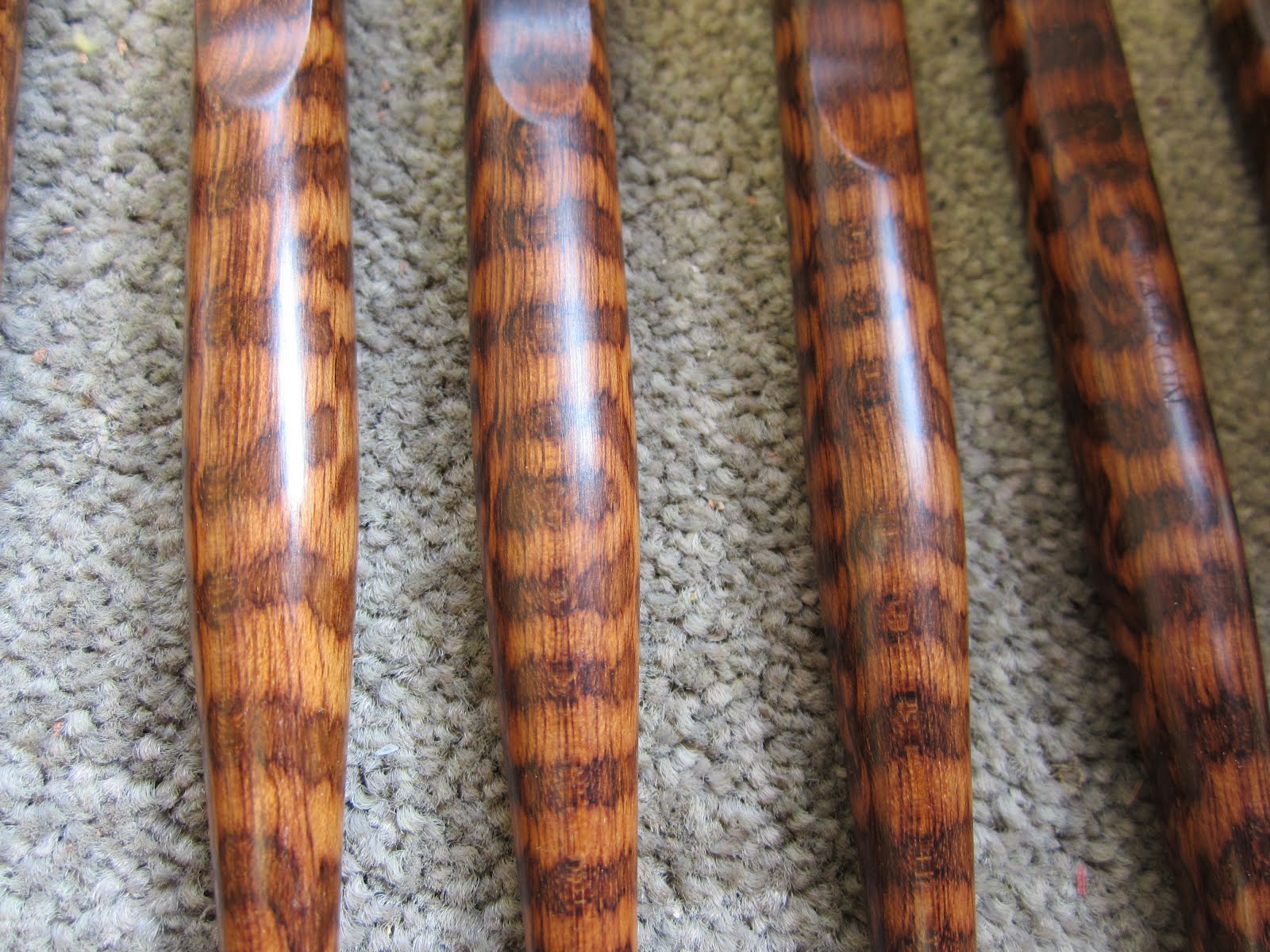
Snakewood marking knives

I've had a bit of a run on my snakewood marking knives so it's time to restock. Here is a small log costing £100 cut into two.

Here is the inside which shows how wasteful this fine wood can be, the snake pattern only goes about half way in and the centre has decayed.


Here are 26 usable blanks which makes them about £4 each. Wood doesn't come much rarer or expensive than this! These blanks will be taken to Jim my turner friend, he is too fast and too good for me to think about turning these myself.


This is the last of the stock turned about 6 months ago. The ferules are simply brass tube cut on my small band saw and the blades are heavy duty Swann Morton which I have shortened.


The blade slot is cut carefully by hand using and old dovetail saw which I sharpened. It has a kerf of .6mm which matches the blade width nicely.
Notice the way my index finger is curled into a notch on the handle rather than pointing down the blade. I find this easier to control the saw and it prevents you from applying too much pressure which can cause the line to wander. I have noticed on some of the high end current day saws that the makers have cut this notch but left it far too small to actually be used as it was intended, which is a shame.


The maker is stamped Hill late Howell on the steel back. Two names were often used for a period after a maker took over anothers business, usually after he had died, hence the use of the word 'late'. From memeory this dates this saw to the 1850's, I like old tools and it's nice to put them back in service.